
What is “rounding error” on Kalshi Climate Markets?
When you trade temperature markets on Kalshi or Polymarket, you’re betting on a very simple number:
The day’s official high temperature (TMAX) as recorded in the National Weather Service’s Daily Climate Report (CLI).
But the CLI value isn’t a raw, continuous measurement. It’s the end result of:
- hardware sampling
- software pipelines
- averaging windows
- rounding
- truncation
- Celsius/Fahrenheit conversions
- legacy DOS-era limitations
- missing 0.1°C precision
- inconsistent NWS display logic
and all of it flows from ASOS, the Automated Surface Observing System.
The term “rounding error” refers to the difference between the actual physical temperature and the rounded/processed number that ends up in the CLI-often 1-2°F off, sometimes more, and sometimes in a direction not visible on any public chart.
This is why markets can “resolve to a number nobody saw.”
What ASOS Is and Why It Matters
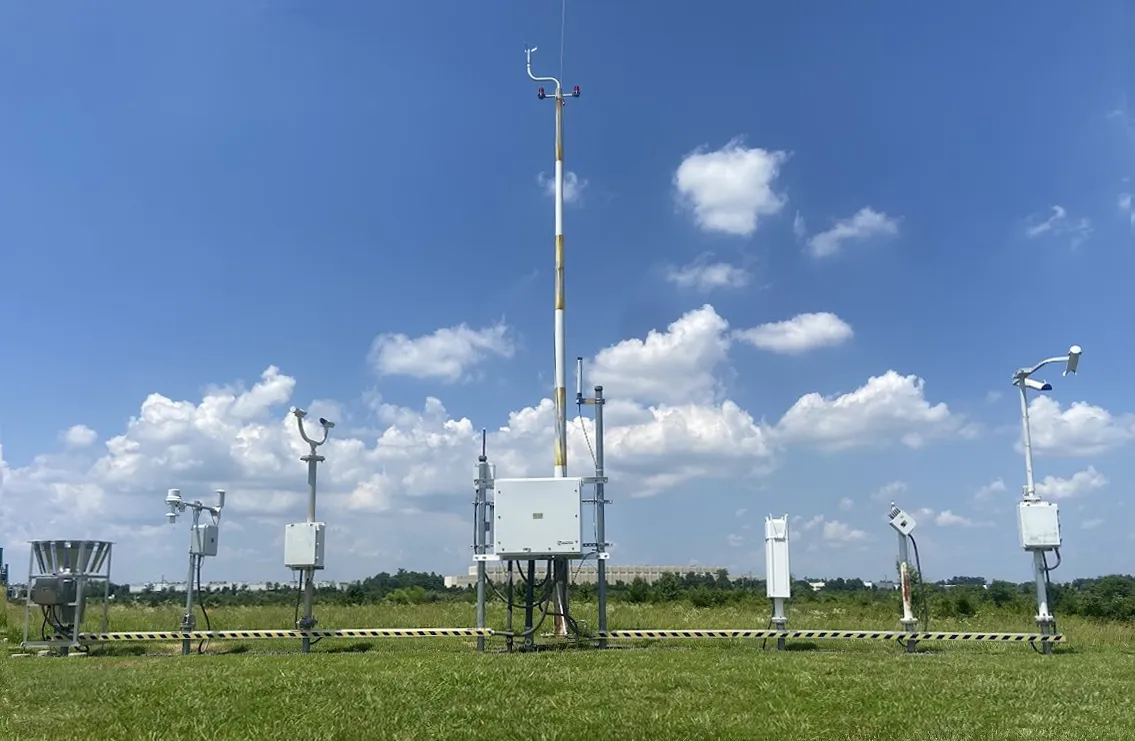
An ASOS Station is a self contained installation of various Weather Sensors, typically including Temperature, Wind, Pressure, and other sensors, that transmit this data continously. These systems are installed throughout the country, at airports and other public locations. Mostly for the safety of pilots, they do provide additional information for Forecast models the National Weather Service uses. They are typically accessed by radio, some of them you can even call from your phone, but the line is usally busy as only one person call at a time and the phone number is reserved for emergencies.
They do transmit data continously but the rate at which the data is transmitted varies, in general they transmit every few minutes to the NWS and FAA.
Almost every U.S. airport has one and some kind of Automated Weather Observing System (AWOS) is required by the FAA at most Airports.
Most ASOS hardware is decades old. Some installations are first-generation systems. Others are third-generation upgrades. Modernization is underway, but not complete, so behavior varies by airport and firmware.
ASOS stations broadcast data constantly. Data is transmitted in the following ways:
- VHF radio broadcasts
- METAR messages
- “High Frequency” METARs (ASOS-HFM)
- 1-minute observations
- 5-minute samples
- NCEI ingestion
- FAA backhaul lines
- NWS internal feeds
But not all of these feeds contain the same precision, and not all are public.
How ASOS Measures Temperature (The Hardware)
The hardware that senses temperature is typically a platinum resistive temperature sensor (RTD), sometimes referred to as a thermistor. This is a specially designed electrical conductor that changes it’s resistivity to electrical flow as the temperature changes. Temperature sensors are usually placed 2 meters off of the ground at ASOS sites.
The raw Fahrenheit precision is very high, finer than 0.1°F.
It measures temperature every few seconds and produces:
- Raw sensor voltage → converted to degrees Fahrenheit
- Averaged over a short sampling window
- Packed into a 1-minute observation
- Optionally averaged again into a 5-minute sample
- Then converted (sometimes inconsistently) to Celsius for transmission
Where Rounding Actually Happens In The Pipeline
This is the single biggest source of confusion.
ASOS reads temperature in Fahrenheit.
But many downstream feeds require Celsius.
So ASOS:
- Measures in high-fidelity °F
- Converts to °C
- Sometimes drops the 0.1°C place entirely
- Sometimes rounds normally
- Sometimes truncates
- Sometimes rounds to the nearest whole °C before transmission
- Downstream systems convert back to °F, often with incorrect assumptions
This chain: F → C (rounded/truncated) → F, is where most market surprises come from.
1-minute feed
- Derived from high-frequency sampling
- Often retains tenths of °C internally
- Not always fully exposed to the public
5-minute feed
- Often rounded to whole degrees Celsius
- Sent to FAA and NCEI
- Used in some NWS products
Hourly METAR
- Includes tenths of °C
- Embedded in the TXXXYYYY group
- Highest publicly visible precision
- Most accurate feed a trader can get
High Frequency METAR (ASOS-HFM)
- Sent every few minutes
- Does NOT include tenths of °C
- Due to a legacy DOS-era software bug1
- Always rounds or truncates to whole °C
- By far the most commonly misunderstood data feed
Because many traders rely on HFM, and HFM is systematically missing precision, they unknowingly work with numbers that can be 1-2°F off from the true temperature.
Types of Rounding Behaviors Observed
Different ASOS systems can (and do) behave differently, but these behaviors are consistently documented:
- Simple truncation
Example:
- 18.6°C → 18°C
- 17.9°C → 17°C
This is where the tenth of a decimal point is simply removed or not transmitted in the data feed and occurs on the ASOS-HFM feed.
- Standard rounding (“baker’s rounding”)
- ≥ 0.5 round up
- < 0.5 round down
Example:
- 21.5°C → 22°C
- 21.4°C → 21°C
All ASOS stations have documented rounding behaviors2, typically values are rounded to a tenth of a decimal Fahrenheit. This means a measurement reading 71.49°F would be rounded to 71.5°F for instance.
- Double conversion rounding
This is the big issue currently
Example:
21.5°C → rounds to 22°C → converts to 71.6°F → converts back → 21°C.
Without the tenth decimal, you sometimes lose the whole degree. The reported/settled number may not resemble the true temperature. NWS has a private feed of data that is not publicly accessible which the CLI is based off of. And they use this feed to create the TMAX in the CLI. So some values may not be reported but do appear as the highest temperature. Other times values that are reported do not actually appear as the TMAX reported because they were never in the data feed, they were simply shown as a result of conversion errors.
- Straight whole-Celsius → Fahrenheit conversion
This happens on NWS websites.
Example:
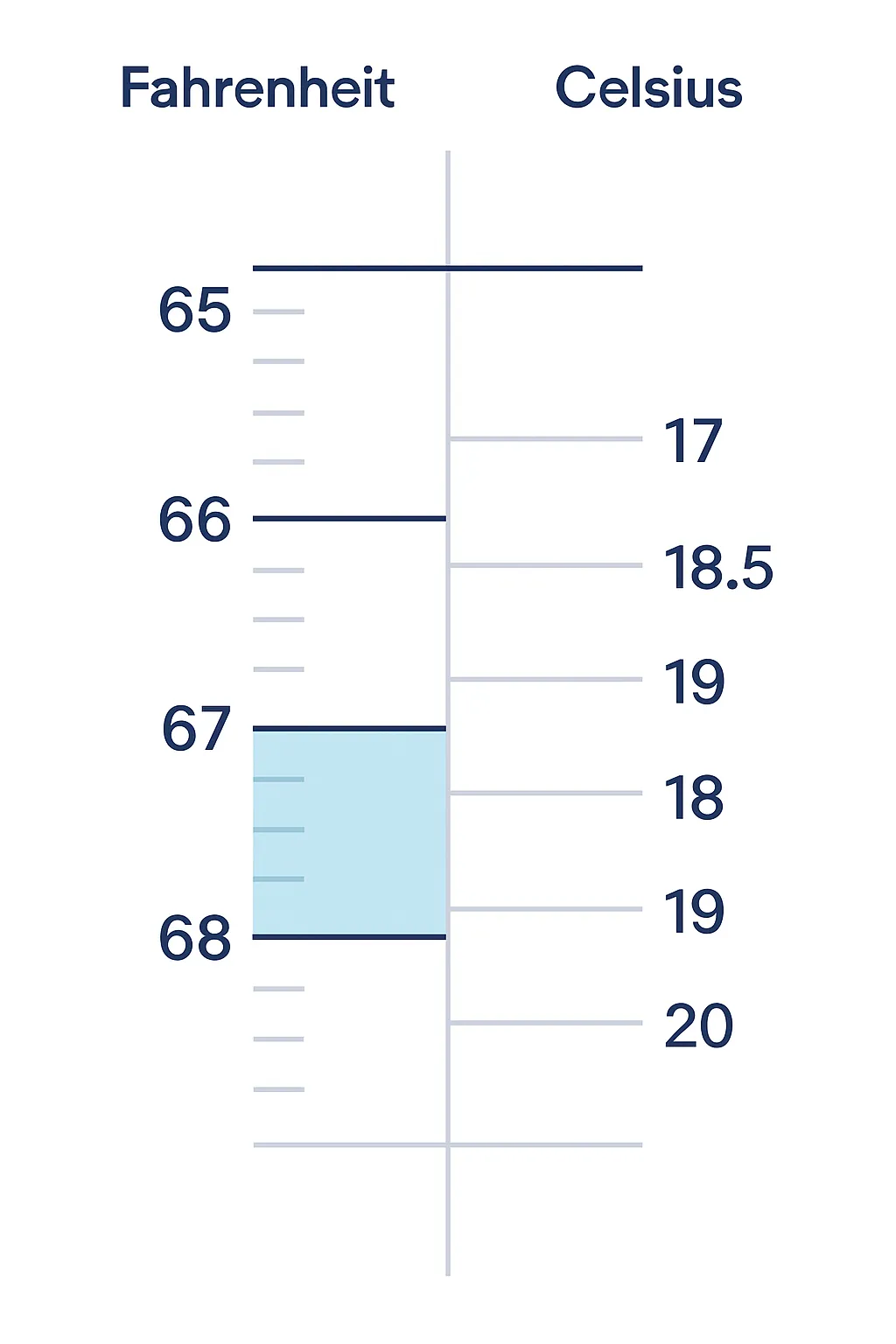
18°C displayed as 64°F even though the true Fahrenheit could be anywhere from 64.4°F to 66.0°F.
Why Celsius Causes More Errors Than Fahrenheit
The ASOS station itself reads the data directly into fahrenheit. fahrenheit has more fidelity than celsius, consider thermostats for the home in the USA typically have fahrenheit controls that allow you to set 1 degree up or down which is usally appropriate to setting the temperature. But in international countries, they typically allow .5 changes, so you can set the temperature to 21.5 or 20.0. This is because Celsius is lower fidelity, as-in each degree in Celsius is larger then a degree in Fahrenheit. The temperature from 0°C of freezing water to boiling water 100°C is a smaller range, then that with fahrenheit, 32°F to 180°F.
Takeaway: Celsius is less precise than fahrenheit in terms of whole digits.
Examples of Feed Differences (HFM vs Hourly METAR)
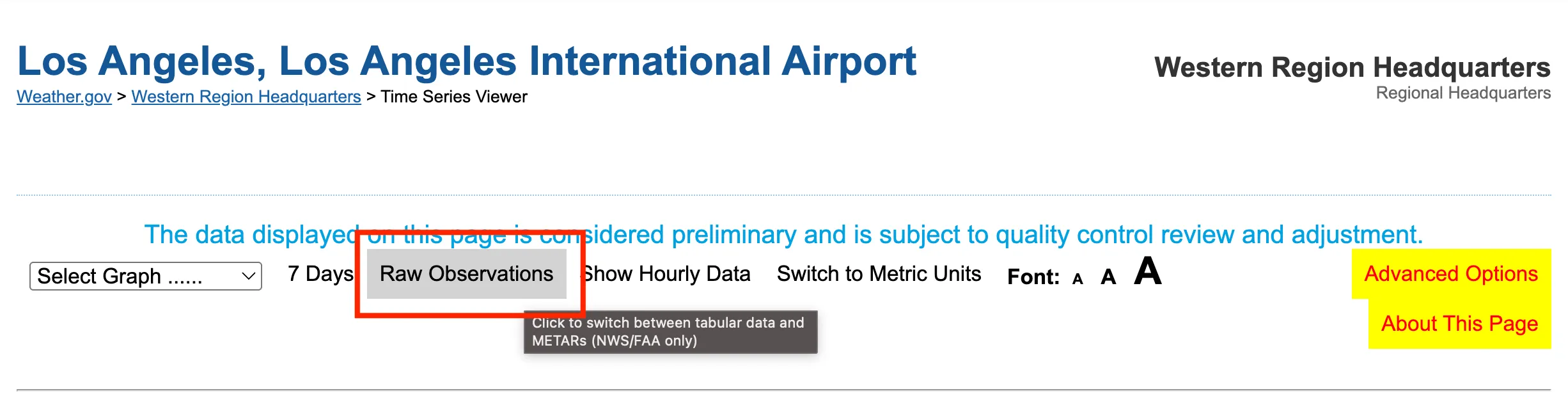
You can see “RAW” observations, the actual METAR message that is sent from ASOS stations on the NWS website. If you click the the raw observation button at the top on any weather station, you’ll see a list of recent messages.
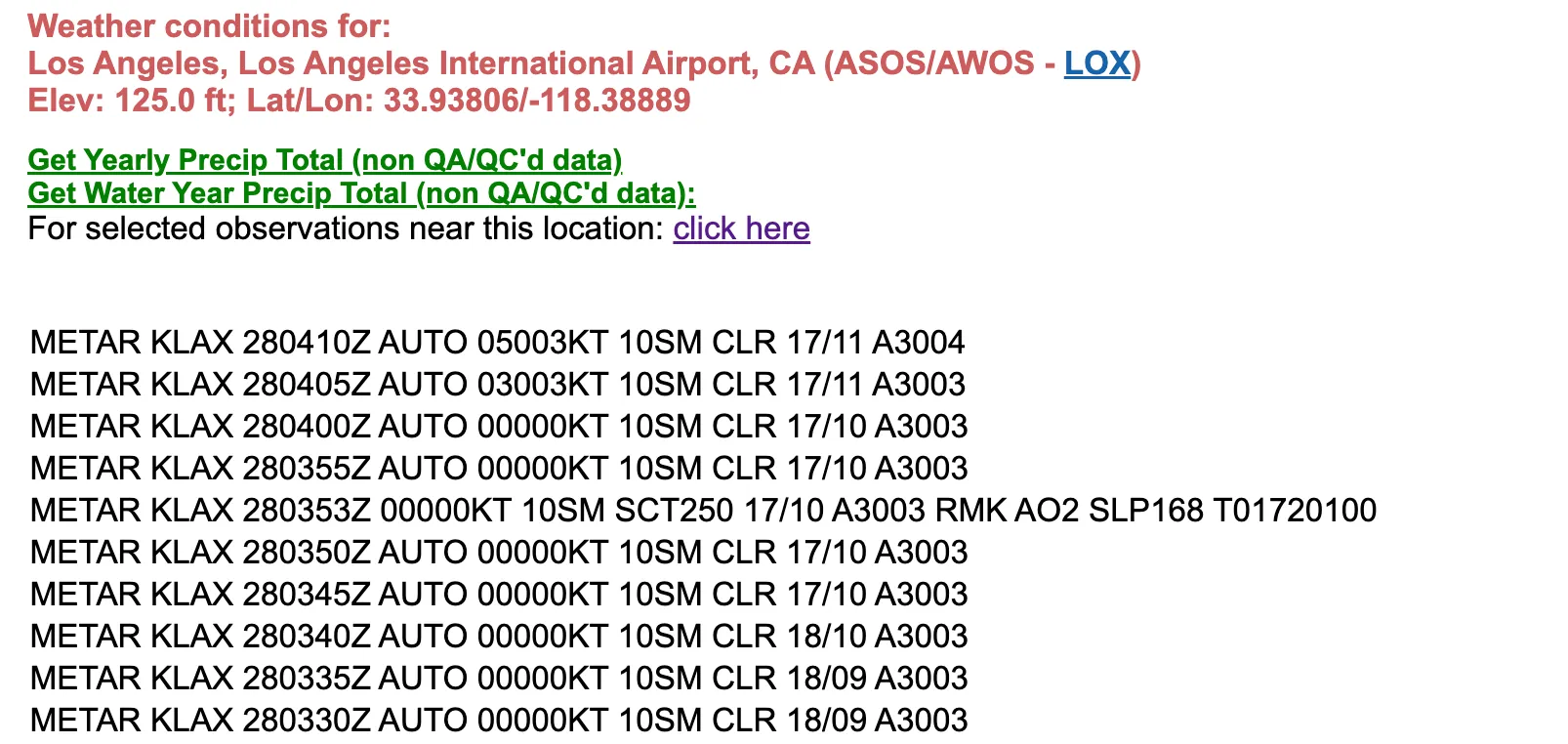
If you look closely you’ll see most are shorter but some are long. Here’s some examples.
METAR KLAX 280255Z AUTO 26005KT 10SM CLR 18/11 A3002
METAR KLAX 280253Z 26005KT 10SM SCT250 17/11 A3002 RMK AO2 SLP165 T01720106 51008
The first METeorological Aerodrome Report (METAR) is a High Frequency Message. This is typically sent from most ASOS stations every few minutes.
The second METAR is the Hourly Message, sometimes called the Summary Message. It has more information and is typically the actual message that is broadcast to nearby aircraft for the duration of the hour. This is sufficient information for most aircraft but not sufficient to tell us degree accuracy of the measurement.
Sometimes there will be Special updates more frequent than the hour because of incliment weather or other conditions. This message is referred to as SPECI for Special Message.
METAR KLAX 280255Z AUTO 26005KT 10SM CLR 18 /11 A3002
 METAR KLAX 280253Z 26005KT 10SM SCT250 17/11 A3002 RMK AO2 SLP165 T0 172 0106
51008
The highlighted portion in the message represents the temperature reading in degrees celsius.
The Hourly message is decoded as 17.2°C. While the high frequency message is decoded as 18°C. High Frequency METAR messages at this time do not send the tenth decimal due to a bug in the DOS software that runs on ASOS Stations1.
This creates the precision/rounding error because as we currently understand the tenth decimal digit is actually there (it was measured but not sent) and is needed for an accurate conversion to fahrenheit.
If you interpret this data incorrectly, this is frequently referred to as the “Rounding Error”. And also causes confusion when temperatures are seen on the NWS website but not reflected in the TMAX.
Correcting Misconceptions (e.g., NWS Timeseries Charts)
On the NWS website you’ll see charts and tables of temperature readings. They’re all incorrect. The NWS does specify that their data may be 1-2 degrees off.3 This is fine for weather forecasts and aircraft where 1-2 degrees does not make much difference. But can cause critical issues for climate markets when conversion errors in your data feed mean the difference wins and losses.
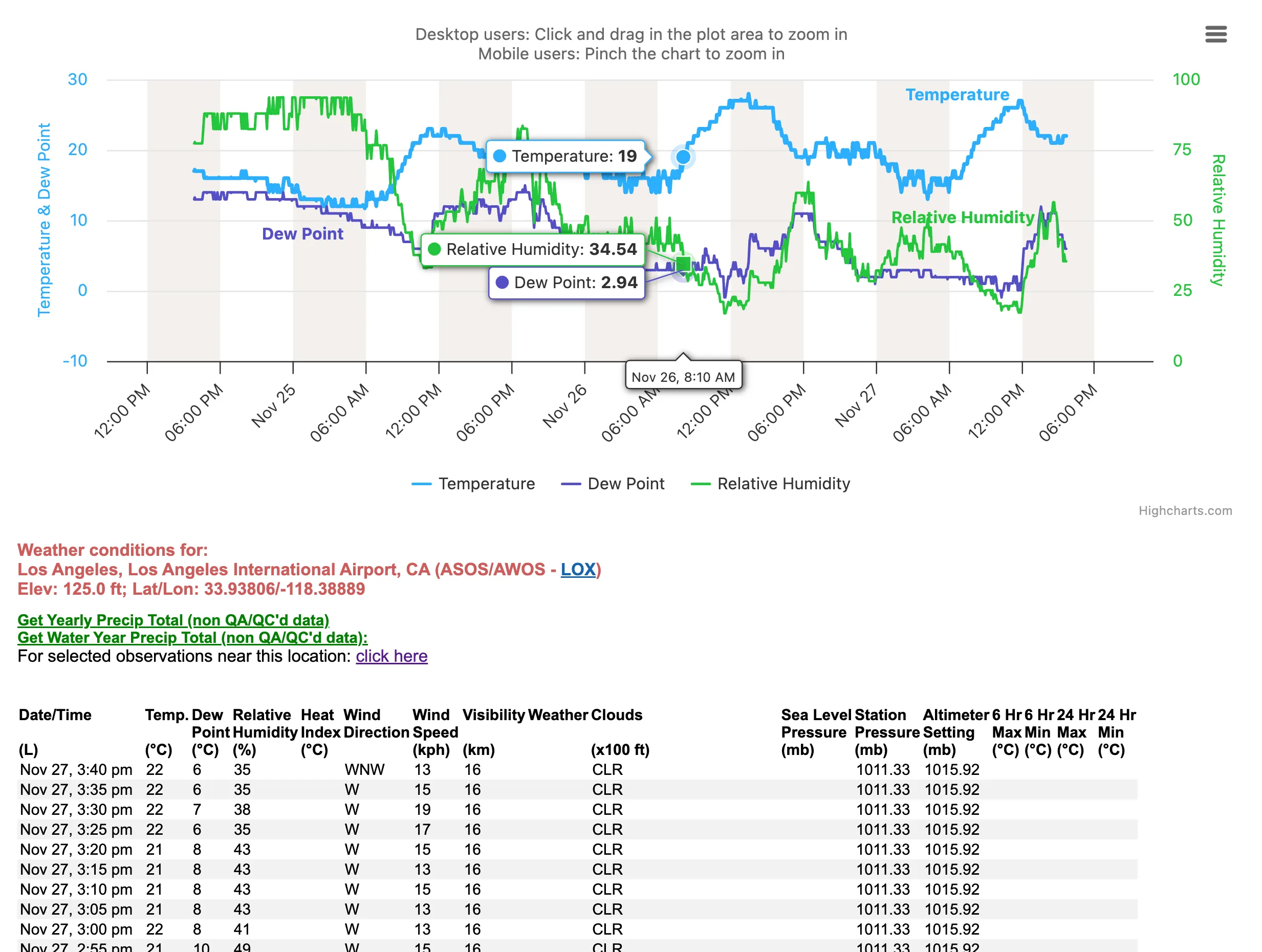
But when the temperature is very close to 70°f, the climate markets can go either way based on the data available. There’s also information related to the 1 minute feed sampling that isn’t publicly available that can flip a market.
NWS Charts are wrong, and their conversions are wrong. To see how bad of a resource it is for climate markets, switch to metric.

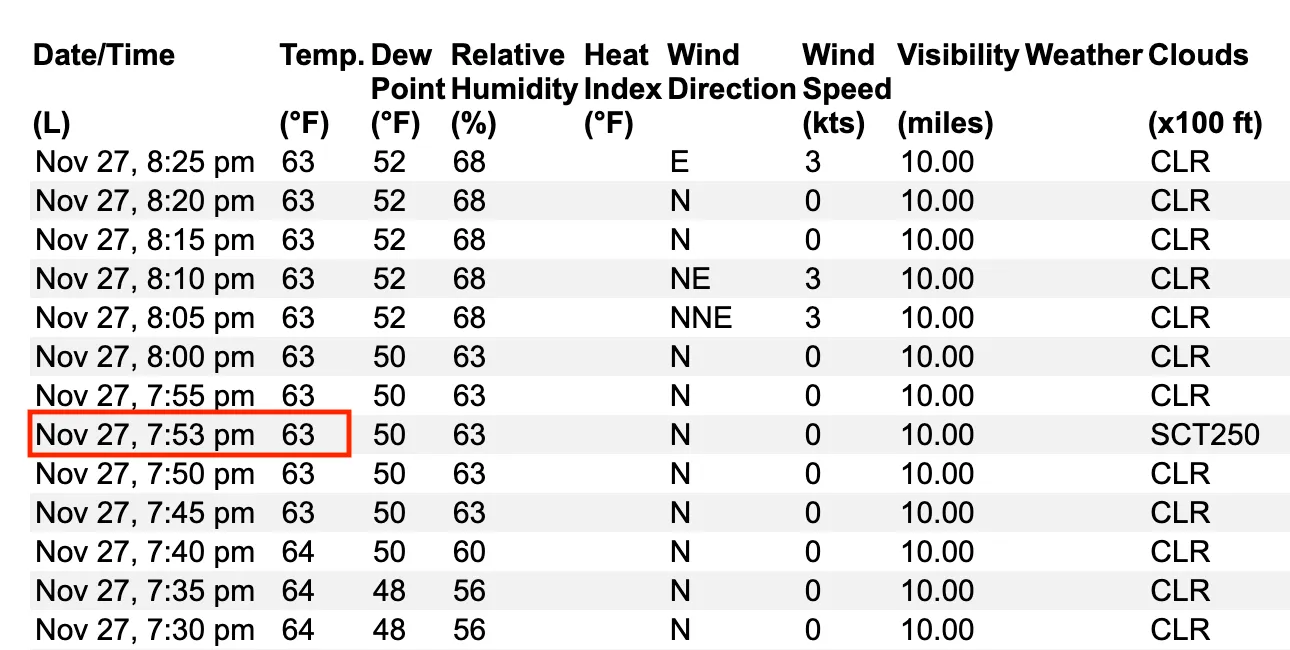
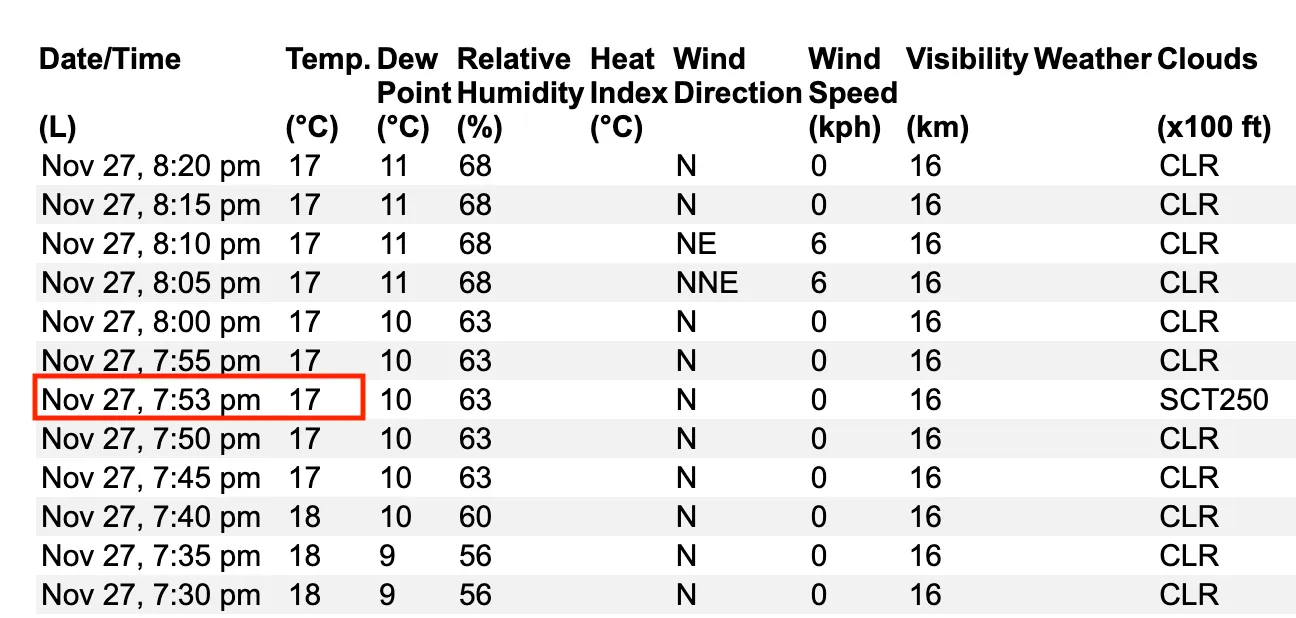
Both the metric and fahrenheit values do not show the tenth of a decimal. And some of the values that show the tenth of a decimal in the chart are also incorrect. NWS is not a great resource for accurate data feeds based on our research.
Climate Sight’s Mitigation Strategies
To mitigate the effects of ASOS-HFM being misinterpreted our forecasts show the maximum accuracy with each measurement that can currently be interpreted from the message. Hourly messages, SPECI, and Daily Summary Messages (DSM) can be accurately shown with a tenth decimal digit and correctly converted to a fahrenheit value.
But ASOS-HFM messages cannot, because the tenth decimal digit is missing, the temperature could be off by as much as 2 degrees fahrenheit in some cases.
Practical Takeaways for Traders
Further reading
-
https://mrcc.purdue.edu/national-regional-weather-networks/details
-
https://www.weather.gov/media/asos/ASOS%20Implementation/release_notes_310_final.pdf
Citations
Apply this in live markets
Turn this guide into concrete trades with the live tools and coverage.